Concept Elements Inc. and SPR Cut Drive Weather Trip Assistant Response Time by 80% with Claude

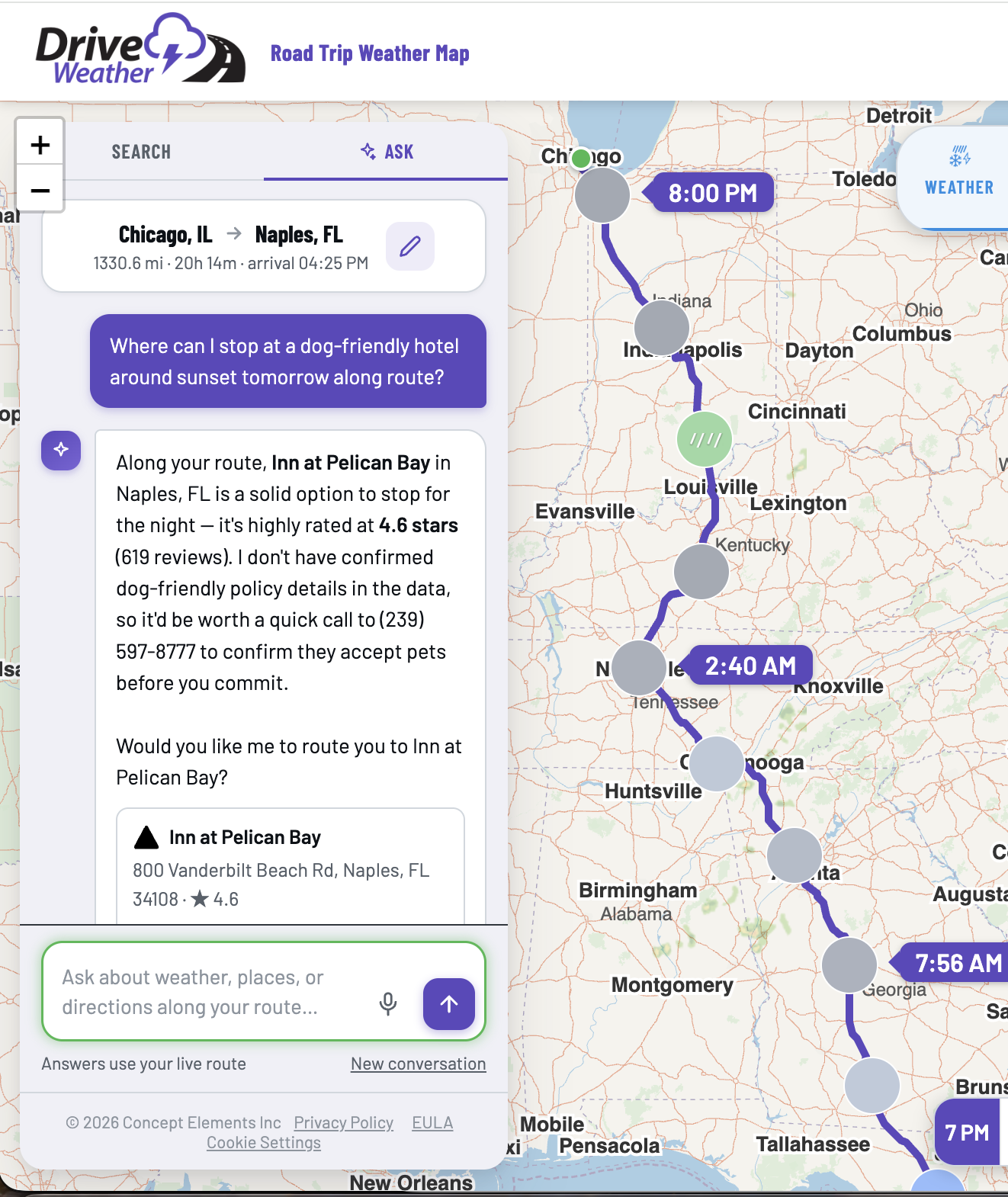
“Find me a non-chain burger joint along my route around 1 p.m. but keep me out of a major city.” “Where can I stop at a dog-friendly hotel around sunset?” “Should I leave now or tomorrow morning for better weather?”
Questions like these are part of planning a long drive. The answer depends on where a driver will be at a particular time, the conditions they will encounter, and the type of stop they want to make.
Concept Elements Inc. created Drive Weather to show weather along a route at the times drivers are expected to reach each point. Concept Elements and SPR collaborated to extend that experience with a Claude-powered trip assistant. Live on iOS, Android, and driveweather.com, the assistant lets drivers ask detailed questions about the journey in everyday language.
The challenge: Making search useful for a moving trip
A restaurant search can return popular places near a city. Finding a non-chain burger joint around 1 p.m. along a specific route, while avoiding major cities, is a different task. A dog-friendly hotel search becomes more useful when it accounts for where the driver will be around sunset. And a departure-time question requires comparing the weather a driver would encounter along the route under different plans.
Concept Elements wanted to answer these combined questions in a single experience. The assistant needed to bring together the driver’s route and timing, weather information, and current information about places to stop. It also needed to respond quickly enough to be practical for trip planning.
SPR’s approach: Design for depth and speed
SPR helped Concept Elements design the agent architecture, select an approach to model use, and establish the framework for route-aware answers. SPR also supported implementation and reviewed the solution during development.
The architecture combines defined application logic with agent-driven reasoning. Route and trip data provide the context for a question. The agent can draw on weather information and web search when an answer requires more detail. Claude interprets requests that include multiple preferences or constraints and brings the relevant information together in a response.
SPR and Concept Elements also built guardrails into the agent workflow. These help keep the assistant’s flexible reasoning connected to the trip and the information available to it. The team designed the workflow to avoid unnecessary steps while still giving the agent room to handle questions that do not fit a fixed list of commands.
The production service runs on AWS EC2 and calls the Anthropic API directly. It uses Claude Fable 5.1, Claude Sonnet 5, and Claude Haiku 4.5.
Results: Answers five times as fast
An earlier design took about 50 seconds to respond. The new design takes about 10 seconds, representing an 80% reduction in response time, or 40 seconds saved per answer in that comparison.
SPR’s architecture, model strategy, implementation support, and review also helped Concept Elements bring the assistant to market faster. The experience is now live across Drive Weather’s iOS and Android apps and at driveweather.com.
For drivers, the result is a way to ask about the road ahead in their own words. They can explore stops that fit their timing and preferences or compare how a change in departure time may affect the weather they encounter. The assistant builds on Drive Weather’s central idea: the useful forecast is the one for where you will be when you get there.
Technology
Claude Fable 5.1, Claude Sonnet 5, Claude Haiku 4.5, Anthropic API, AWS EC2, route and weather data, and web search.