How to Choose an AI Consulting Firm

Everyone’s an AI expert these days. Scroll through LinkedIn for five minutes and you’ll find no shortage of consultants, agencies, and solo operators claiming to be at the cutting edge of artificial intelligence. So how do you separate the firms that can genuinely move the needle from those that are just riding the hype wave?
Here’s what actually matters when evaluating an AI consulting firm, and a few red flags to watch out for along the way. A strong AI consulting services partner should connect strategy, governance, architecture, delivery, and continuous improvement, not just deliver a demo.
First, Do You Actually Need One?
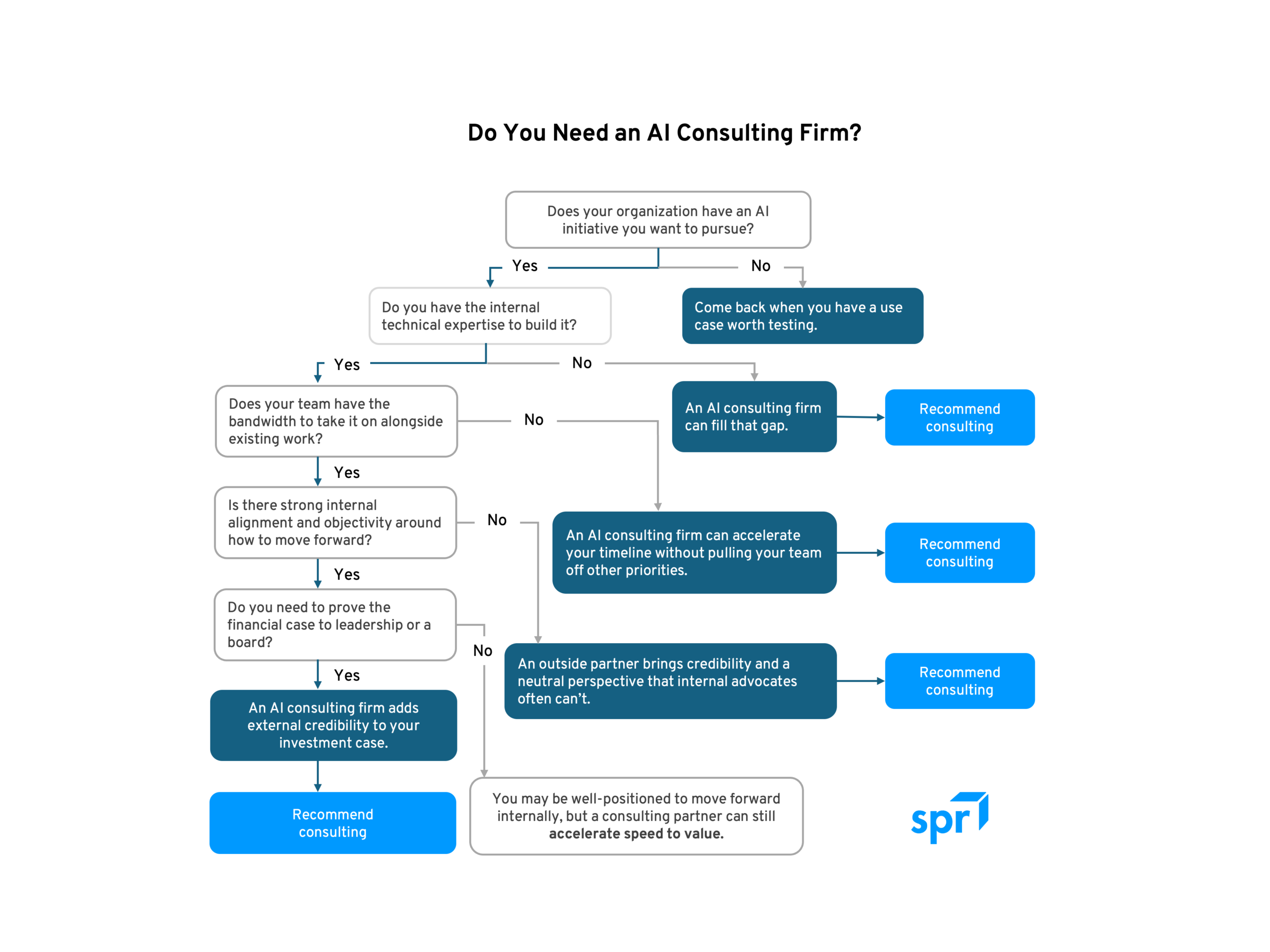
Before evaluating firms, it’s worth asking whether you need an outside partner at all. The answer usually comes down to three things: bandwidth, expertise, and speed. If your biggest challenge is deciding where to focus first, an AI strategy you can execute can help turn scattered ideas into a prioritized use-case portfolio, governance model, and rollout plan.
Many organizations have strong engineering teams, but those teams are already stretched. They’re keeping existing products running, managing internal systems, or supporting something else entirely. Even companies that invested in data science or ML capabilities a decade ago often find that their teams don’t have the capacity to take on new AI initiatives alongside their day jobs.
If you have the talent internally but not the time, a consulting firm fills that gap. If you need something done quickly, an outside partner can accelerate the timeline significantly. And sometimes, even when a company has both the skills and the bandwidth, an external firm brings something harder to manufacture internally: objectivity. Organizations with a lot of internal momentum, relationship dynamics, or competing priorities often benefit from a third party that can cut through the noise and get people aligned.
There’s also the matter of proving an investment case. When you need to demonstrate financial viability to leadership or a board, an outside firm brings credibility that internal advocates sometimes can’t.
What Kind of Company Gets the Most Value?
The organizations that see the greatest return from AI consulting work tend to share a few traits.
- Looking to transform how you work: They’re not just looking to swap in new technology; they want to transform how work gets done. They understand that the value they get out of a partnership is directly proportional to the effort they put in. If you’re expecting a firm to come in, build something spectacular, and hand it off with minimal involvement from your side, you’re likely to spend a lot of money and capture very little of the value.
- Investing in your people: The companies that benefit most are also the ones investing in their people through the transition, not just reducing headcount or automating roles away, but thinking seriously about what their teams will do more of, and better, with AI as a tool. This is especially relevant for companies in industries where change has traditionally been slow. When people have been doing something one way for 20 or 30 years, even if they genuinely want to evolve, it’s hard to see past what’s always worked. That’s where a strong consulting partner can help: not by dictating a path forward, but by helping an organization find its own. The right partner should also help with AI adoption and enablement, preparing people, processes, governance, and workflows so AI can scale beyond the first build.
What Qualifications Should You Look For?
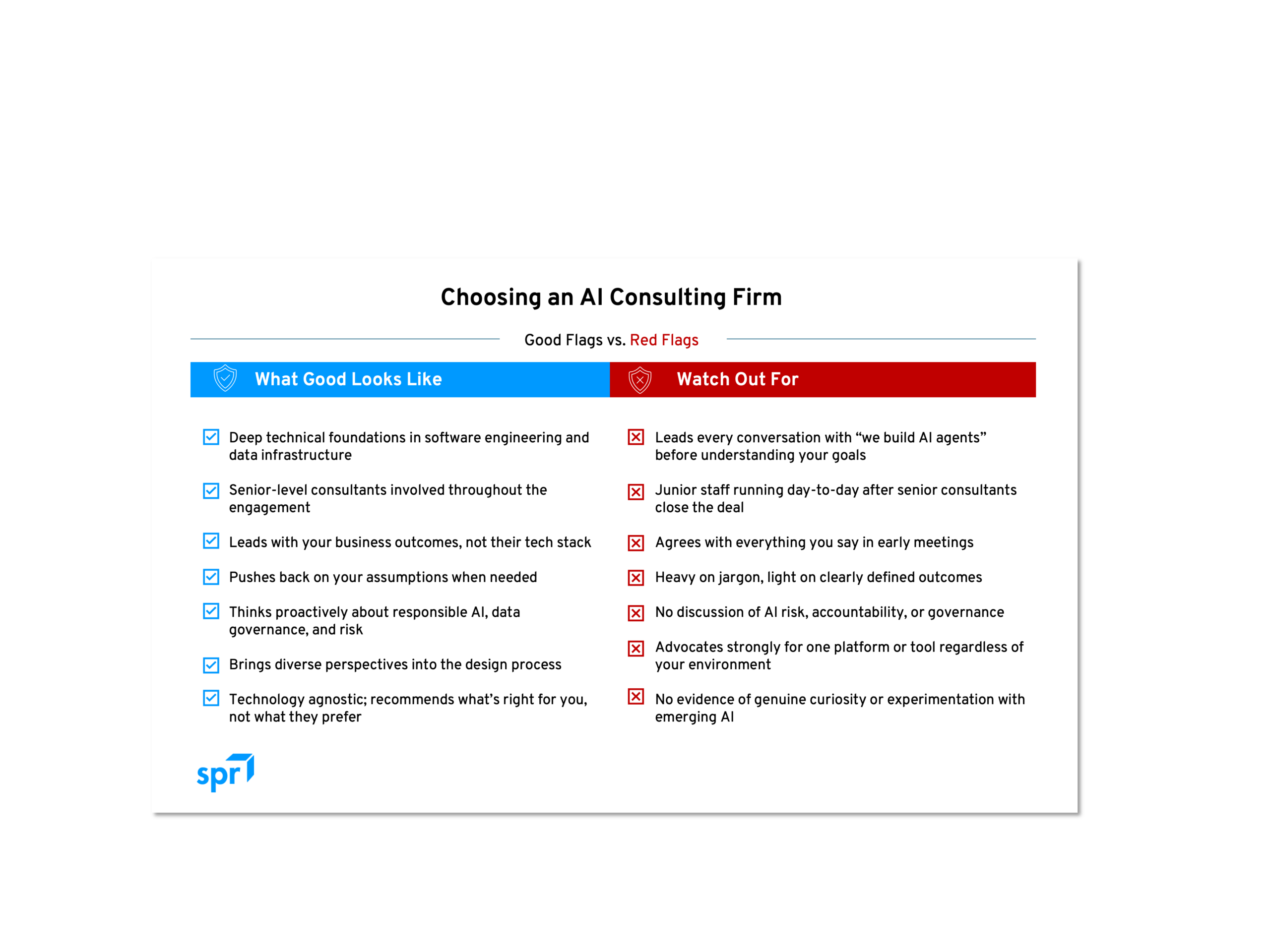
Deep technical foundations are essential. A firm only familiar with building in Jupyter notebooks on local machine is not equipped to deliver enterprise solutions. Look for firms with strong software engineering and data infrastructure skills. AI relies on sound systems, pipelines, and architectures. A team that recognizes data foundation issues is more valuable than one that just delivers quick fixes regardless. For LLM-heavy work, look for LLM integration experience that goes beyond calling a model API. The partner should understand model selection, secure deployment, architecture, evaluation, and how the solution fits into existing enterprise systems.
Long-term technical experience, not just AI experience. Technical expertise is becoming democratized rapidly. Someone who has been building AI agents for six months is not the same as someone who has spent 20 years as a software engineer and is now applying that experience to AI. Look for firms where the senior people have genuine depth, not just in AI, but in building and deploying complex systems over time. That experience is what lets them see the potholes before you fall into them.
Industry experience is a plus, not a prerequisite. If you’re choosing between two equally strong firms and one has experience in your industry, go with them. Knowing the right questions to ask in manufacturing or financial services accelerates the design phase meaningfully. That said, a technically excellent firm without your specific industry background can absolutely get there. The best ones are curious, do the research, and ask smart questions.
A partnership mentality, not a build-and-leave approach. AI transformation is fundamentally different from a traditional technology implementation. It’s not just changing how your people work; it’s changing what they work on. A firm that comes in, builds something, and hands it off is not set up to deliver lasting value. Look for partners who talk about your workforce, your customers, and your business goals first, and treat the technology as the means, not the end.
One telling signal: does the firm lead with AI or with outcomes? If every conversation starts with “we do agents” or “we build AI,” be cautious. The firms worth working with will want to understand your goals first and let the technology follow from there.
Senior-level involvement throughout the engagement. One of the advantages smaller consultancies have over the major players right now, and it’s a real one, is that their senior people are actually doing the work. At a large consultancy, the managing director shows up for the big calls, but a less-tenured analyst is running the day-to-day. With AI, you need your most experienced designers and architects deeply involved, especially in the early design phase. That senior attention isn’t always present at the big firms, and it matters.
Questions to Ask in the Interview Process
Ask for case studies and make them tell the story. Anyone can put together a polished deck. What you want to hear is how a firm actually worked through a problem: what went sideways, what they had to rethink, how they navigated a failed pilot or a client that wasn’t ready. That kind of candor tells you a lot about how they operate under pressure.
Ask how they structure the AI pilot process, including how they move from POC to pilot to full deployment without turning early momentum into an expensive science project.
A note of caution here: be realistic about what to expect. AI is still new. Not every firm that is genuinely excellent will have a case study that matches your exact use case. What you’re assessing is creativity, problem-solving, and commitment to quality, not a perfect niche match.
Test their technology agnosticism. A trustworthy firm should be able to work within your environment, not push you toward their preferred stack. If you’re hearing a lot of advocacy for one platform or tool, probe further into that. The right answer is almost always “it depends on what’s best for you.”
Ask what they’re building in their own time. This one might seem unconventional, but it’s revealing. The people who are genuinely on the cutting edge of AI are obsessed with it. They’re experimenting at home, playing with new models, tinkering on side projects. If no one at the firm is doing that, if there’s no one who lights up talking about what they’re exploring, that’s a sign they’re not keeping their finger on the pulse. And in a field moving as fast as AI, that matters.
Red Flags to Watch For
They never push back. If a consulting firm agrees with everything you say in the first couple of meetings, that’s a problem. Good partners challenge your assumptions. They ask whether you’ve thought about something differently. They hold what’s best for you in mind, even when its uncomfortable. A firm that just says yes to everything will build you exactly what you asked for, which may not be what you actually need.
They’re heavy on jargon, light on substance. If you can’t determine the actual value of what they’re proposing from their pitch, that’s a red flag. There’s a lot of smoke and mirrors in the AI consulting space right now. If a firm can’t clearly articulate what they do and what outcomes you should expect, move on. A credible firm should be able to explain how they will measure AI success before anything gets built, including the outcomes, baselines, adoption signals, and risk measures that will prove whether the work is worth scaling.
They’re not thinking about responsible AI. This isn’t just a values question; it’s a business risk question. AI systems introduce liability, accountability, and risk management considerations that didn’t exist before. A firm that isn’t asking those questions during the design phase isn’t protecting you. Look for partners who think intentionally about responsible use, including things like model selection, data governance, and the real-world implications of what they're building.
They don’t have diverse perspectives at the table. AI systems reflect the perspectives of the people who design them. A firm that’s intentional about bringing diverse viewpoints into their process will build better, more robust solutions and will be better equipped to anticipate blind spots before they become problems.
The Bottom Line
Choosing an AI consulting firm isn’t just a procurement decision. It’s a decision about who you’re trusting to help your organization navigate a genuinely significant transition. The right firm won't just build something and leave. They’ll help you figure out where you want to go, build the internal clarity and alignment to get there, and put structure around what can otherwise be a long, circular conversation that never moves forward.
The best analogy might be this: a good AI consulting partner is part therapist, part life coach, and part architect, helping you channel your energy in the right direction, with the technical expertise to actually build what you need once you know what that is.
That combination is rarer than the market would have you believe. But it exists, and it’s worth looking for.
If your organization is evaluating AI partners or trying to bring structure to scattered AI efforts, SPR can help you clarify the right use cases, assess readiness, build governance, and move from strategy to production with confidence.